Featured
This Day in History Instagram Reels
We're On Instagram
Armies do not move on ideals alone. They move on credit, trust, and the willingness of individuals to risk everything on an uncertain future.
Robert Morris, often called the “Financier of the Revolution,” played a decisive role in sustaining the American war effort when resources were scarce and confidence fragile. As Superintendent of Finance, Morris leveraged his own reputation and personal wealth to secure loans, stabilize currency, and keep the Continental Army functioning when bankruptcy loomed.
This was not abstract bookkeeping. Morris signed notes others would not. He negotiated credit abroad while calming skepticism at home. His work helped transform a loose rebellion into something approaching a functioning state—capable of paying soldiers, supplying campaigns, and honoring obligations even before independence was secure.
Financial power during the Revolution carried moral weight. Decisions about debt, risk, and sacrifice shaped not only military outcomes, but the kind of nation that might emerge afterward. Morris’s legacy reminds us that independence depended as much on credibility and restraint as on courage in battle.
Learn more about the financial foundations of your patriot legacy here: https://sar.org
These posts are designed as accessible entry points into Revolutionary-era history for broad audiences; while we strive for accuracy, they are not intended as exhaustive academic treatments—thank you for supporting public history and respectful dialogue.
…
15
1
Before treaties were signed and flags were raised together, support for the American cause moved quietly—through ports, warehouses, and unofficial channels.
Long before France formally allied with the United States in 1778, French officials and private agents supplied the Continental cause with critical material aid. Muskets, powder, uniforms, artillery, and funds flowed across the Atlantic under layers of diplomatic caution. Officially, France claimed neutrality. In practice, it watched Britain’s struggle with growing interest—and opportunity.
This early aid mattered enormously. The Continental Army faced chronic shortages of weapons and supplies that local manufacturing could not meet. French matériel helped arm soldiers, standardize equipment, and sustain campaigns at moments when collapse was a real possibility. Just as important, the aid signaled that the rebellion was being taken seriously on the world stage.
Yet this support came with risk. Open alliance too early could have triggered war before the Americans proved they could endure. French leaders balanced strategy against uncertainty, testing whether the new nation could survive long enough to justify full commitment.
The Revolution was never fought in isolation. Independence depended not only on battlefield victories, but on diplomacy, patience, and the slow accumulation of trust across oceans.
Learn more about the international forces that shaped your patriot legacy here: https://sar.org
These posts are designed as accessible entry points into Revolutionary-era history for broad audiences; while we strive for accuracy, they are not intended as exhaustive academic treatments—thank you for supporting public history and respectful dialogue.
…
49
3
The American Revolution was fought not only on battlefields and council floors, but across kitchen tables, letter pages, and long separations that reshaped families forever.
Wartime loyalty was rarely simple. Husbands and wives, parents and children, neighbors and communities often found themselves divided by allegiance, geography, or necessity. Enlistment meant prolonged absence. Commerce collapsed. Homes became supply points, hospitals, or targets. Love endured, but it was tested daily by uncertainty, fear, and loss.
Letters from the Revolutionary era reveal a quieter side of the war—pleas for safety, concern over provisions, grief carried privately, and hope sustained across distance. Women managed households, farms, and businesses alone. Children grew up amid scarcity. Civilians navigated the Revolution not as ideology, but as lived reality.
The struggle for independence demanded sacrifice beyond uniformed service. It required emotional resilience, patience, and trust in an unfinished future. Remembering this civilian cost reminds us that liberty has always depended on ordinary people bearing extraordinary strain.
As we approach America 250, reflecting on loyalty and love during wartime deepens our understanding of service—not only as action, but as endurance.
Sons of the American Revolution
…
25
2
News

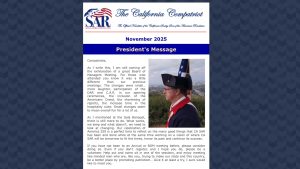
November 2025 California Compatriot
You can read the latest issue of the November 2025 California Compatriot here. It should have also been delivered directly to your email inbox. Several other recent issues of the
December 11, 2025

October 2025 California Compatriot
You can read the latest issue of the October 2025 California Compatriot here. It should have also been delivered directly to your email inbox. Several other recent issues of the
October 30, 2025

September 2025 California Compatriot
You can read the latest issue of the September 2025 California Compatriot here. It should have also been delivered directly to your email inbox. Several other recent issues of the
October 1, 2025